Abstract
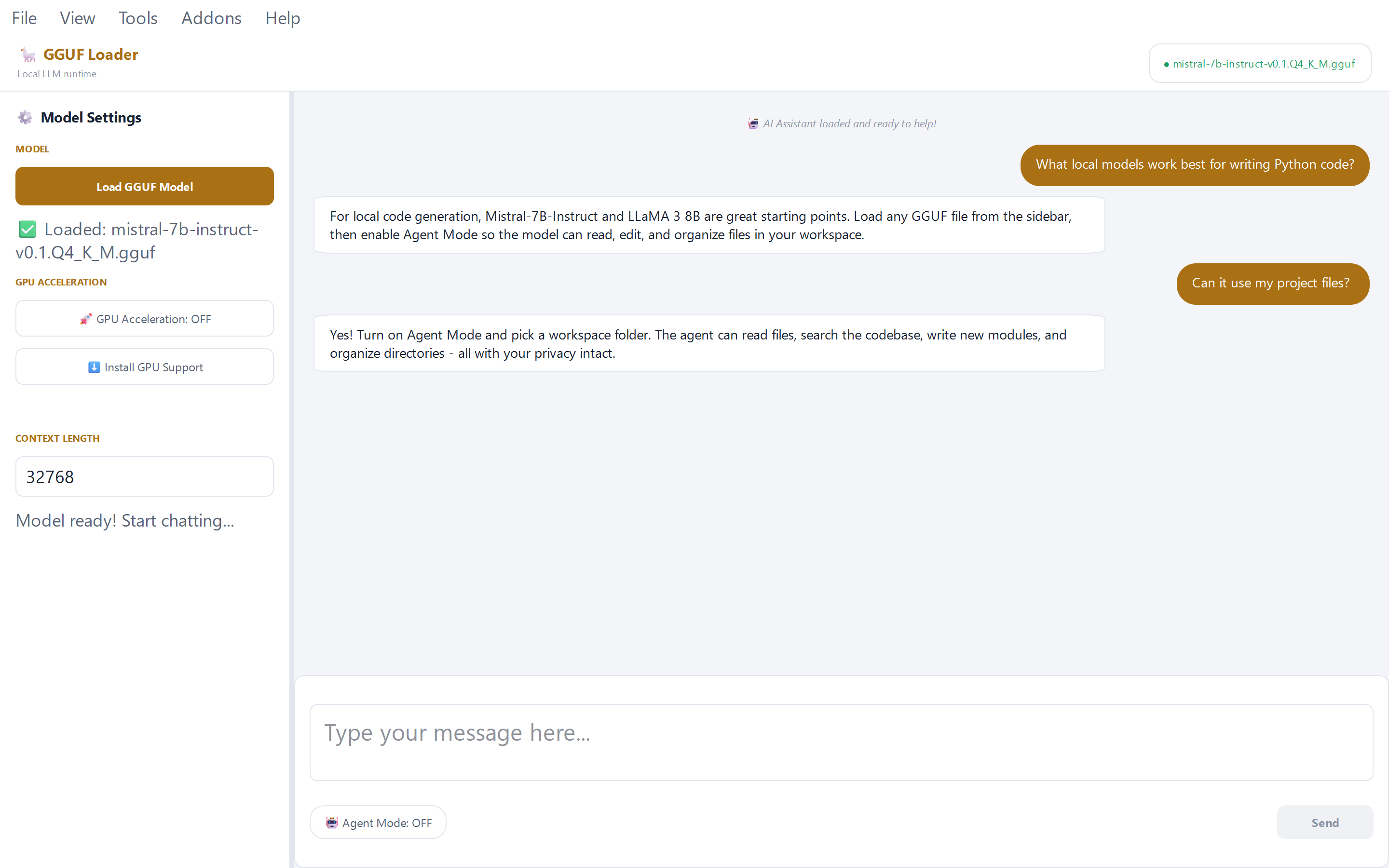
GGUF Loader is an open-source, privacy-first desktop application that makes local large-language-model inference accessible to non-technical users. Built on PySide6 with llama.cpp as its sole inference engine, it loads any GGUF model — from 1.5 GB edge quantizations to 40 GB frontier-class weights — and provides chat, an agentic mode driven by a LangGraph state machine with seven sandboxed tools and approval-before-execution, retrieval-free document search, and full-folder summarization, all without any network dependency. The project has been developed in the open since July 2025, reached v2.2.0 in August 2026, and is distributed both as a desktop application and as the ggufloader PyPI package. This report documents the system's layered architecture, inference engine, agent loop, safety model, packaging, and the ten design principles that govern its engineering.
Keywords: local inference; llama.cpp; GGUF; quantization; LangGraph; agentic AI; tool use; privacy-preserving computing; human-in-the-loop
1. Introduction
Running a capable open-weight LLM on one's own hardware has historically required assembling a system from parts: selecting a model, choosing a quantization, configuring a runtime, juggling CPU/GPU offload, and — for grounded answers — bolting on retrieval by hand. Most practitioners abandon the attempt and route their private data through a cloud API instead. GGUF Loader exists to collapse that entire stack into a single, hardware-aware desktop operation.
The project's thesis is that the 7B-class model is the real user: prompts, tool schemas, retry logic, and defaults are tuned for small local models rather than frontier APIs. This report describes how that thesis is realized across the inference engine (§4), the agent loop (§5), document grounding without a vector database (§6), the privacy and safety model (§7), and distribution (§8), and concludes with the project's explicit 12-month architecture roadmap (§11).
2. Background and Related Work
2.1 GGUF and llama.cpp
The GGUF format, introduced by llama.cpp [1], is the de-facto container for quantized open-weight models, encoding weights, tokenizer, and metadata in a single file. Quantization (Q4_K_M, Q5_K_M, etc.) compresses weights to 4–8 bits, trading a small quality loss for a large memory and throughput win, which is what makes 7–70B models feasible on consumer hardware. llama.cpp [1] provides the portable, highly optimized C/C++ inference runtime; llama-cpp-python [2] exposes it to Python and is the sole engine binding used by GGUF Loader.
2.2 Agentic frameworks and tool use
ReAct-style reasoning-and-acting [3] established the pattern of interleaving model reasoning with tool calls. LangGraph [4] provides a low-level graph abstraction — typed state, nodes, edges, conditional routing, checkpointing, and interrupt()-based human-in-the-loop — that has become a common substrate for production agent loops. GGUF Loader deliberately adopts LangGraph rather than hand-rolling its loop: checkpointed execution and interrupts are requirements, not conveniences (§5).
2.3 Local-first software
A growing body of systems — from the Lawyer Assistant legal RAG system [5] to a range of on-device assistants — argues that data governance, determinism of infrastructure, and predictable economics are properties worth paying engineering effort for. GGUF Loader's contribution is packaging these properties into a single-install desktop product with a non-expert user interface, rather than a developer toolchain.
3. System Architecture
3.1 Layered design
The codebase is split into three layers with strict dependency direction:
| Layer | Contents | Rule |
|---|---|---|
core/ | Inference engine abstraction, agent graph, tool registry, text extraction, search | Pure Python, no Qt — everything testable without a GUI |
services/ | Qt bridges (model, chat, agent, approval, memory, settings, session) | One service per concern; run on worker threads |
ui/ | Main window, chat panel, agent panel, settings dialog, floating chat | Thin rendering; forwards user intent to services |
3.2 Threading and the worker pattern
All blocking work — model load, chat generation, agent steps — runs on dedicated worker threads with signals forwarded to the UI thread. The threading model guarantees the interface never freezes: every long-running operation streams progress events, and every operation is cancellable. A cooperative cancellation contract ensures a cancel request is honored between steps rather than ignored mid-run.
3.3 Addon system
A formalized addon API sits above the composition root, allowing optional components — the floating chat being the reference example — to register panels and behaviors without modifying core code. This is the same extension mechanism the 12-month roadmap formalizes for tools, backends, and memory providers.
4. Inference Engine
4.1 llama.cpp as the sole engine
The engine layer defines a ModelEngine protocol (load, chat, complete, embed) with exactly one implementation: llama-cpp-python. This is a stated non-negotiable ("llama.cpp is the engine, forever") — every LLM and embedding call funnels through one interface, which keeps GPU context ownership, memory accounting, and cancellation semantics uniform. Backends are an adapter detail, not a product feature.
4.2 Serialized execution
The system enforces one model at a time: llama.cpp owns a single GPU context, and all inference funnels through one executor. This avoids the VRAM thrash, context switches, and allocation failures that plague multi-model desktop inference, at the cost of serialized concurrency — an accepted trade for a desktop product.
4.3 GPU acceleration
GPU support is one click: an Install GPU Support button in the sidebar uninstalls the CPU wheel and installs the CUDA-enabled build of llama-cpp-python from the official cu124 index, then shows a live status indicator (green tick when ready). The application detects GPU availability at load time and offloads layers between GPU and CPU automatically when a model exceeds available VRAM. The same flow serves macOS (including Apple Silicon via Metal) and CPU-only machines.
4.4 Model universality
Because the engine is llama.cpp and the container is GGUF, the loader accepts any compatible model file: Mistral, LLaMA, DeepSeek, Qwen, Gemma, and the long tail of Hugging Face quantizations — no conversion, no per-model configuration. Model metadata (context length, layer counts, quantization) is read from the file itself.
5. Agentic Mode
5.1 The graph
Agent mode is a LangGraph StateGraph with the loop START → agent → tools → agent → … → END and conditional routing. The agent node emits a structured tool-call plan; the tools node executes it; the router decides whether to continue or end. The graph supports streaming events, checkpointed execution, and resumption from arbitrary points.
5.2 Tool set
Seven tools are sandboxed inside a user-granted workspace folder:
| Tool | Capability |
|---|---|
| List directory | Enumerate workspace contents |
| Read file | Read text from workspace files |
| Write file | Create or overwrite files |
| Edit file | Surgical, context-aware edits |
| Search files | Find content across the workspace |
| Run command | Execute shell commands (approval-gated) |
| Git | Git operations (approval-gated) |
5.3 Approval-before-execution
Shell commands and git-write operations suspend the run through LangGraph's interrupt() before anything executes, surface an Allow/Deny approval card in the agent transcript panel, and resume from the exact interrupt point with the user's decision — no partial results are lost. This converts the agent from an autonomous actor into a supervised one, which is the project's core safety posture.
5.4 Checkpointing and resumption
Each conversation persists in SQLite via LangGraph's SqliteSaver, keyed by a stable per-workspace thread ID. The same folder resumes the same conversation thread even after an application restart — a requirement the project explicitly chose LangGraph to satisfy rather than re-implement.
5.5 Robustness engineering
Four mechanisms address the reality that small local models are less reliable than frontier APIs: malformed-JSON auto-repair (if the model returns broken action JSON, the agent asks it to fix the payload, with retries, instead of failing); corrective tool retries (failed tool calls get a corrective retry, then are skipped rather than repeated endlessly); streamed final answers (the agent's final response streams token-by-token through the app's callbacks); and cooperative cancellation between steps. The governing principle is explicit: "graceful degradation, never silent failure" — if a 7B model cannot produce valid tool JSON, the system repairs, retries, then falls back to plain chat and says what happened.
6. Retrieval-Free Document Grounding
GGUF Loader deliberately does not ship a vector database. Its Find Paragraph feature answers "where is this in my document?" by having the model itself locate the passage — a planner decides what to read, and per-file progress is streamed live. This trades retrieval-recall for simplicity and transparency: no embeddings to build, no index to maintain, and the model reads the actual file content. Full-folder summaries apply the same philosophy at scale: the agent reads every readable file (Markdown, PDF, DOCX, TXT, source code) before answering, with a visible "reading remaining files…" status.
7. Privacy and Safety Model
- Local-first by default: no cloud, no telemetry, no analytics. Network tools exist only behind explicit user configuration.
- Workspace jail: every tool is confined to the folder the user grants; the model cannot reach outside it.
- Approval gates: anything executable, destructive, or network-bound requires human approval (§5.3).
- Transparency: the agent transcript panel shows plans, steps, tool results, diffs, and approvals — the model's behavior is fully auditable.
8. Packaging and Distribution
GGUF Loader ships three ways: the source repository with launch.bat/launch.sh (which create a venv, verify every pinned dependency, install what is missing, and launch); as a PyPI package (pip install ggufloader, launched with the ggufloader command), restructured into a single collision-proof package namespace so it is safe in shared Python environments; and as a packaged desktop build. In installed-package mode, data, config, cache, and logs live in the per-user data directory rather than site-packages. The project supports Windows 10/11, Linux, and macOS including Apple Silicon.
9. Evaluation
The project's engineering is governed by its ten design principles (§0 of the architecture documents), of which the most load-bearing are: llama.cpp as the only engine; LangGraph as the only agent loop; local-first with no telemetry; safety by default; stream everything and cancel everything; graceful degradation with explicit communication; a pure core with a thin UI; one model at a time with serialized execution; first-class extensibility; and the 7B-class model as the real user. A unit test suite (tests/unit/) exercises the pure core — engine adapter, graph, tools, memory, settings — without requiring a display, and the roadmap calls for real-model integration tests and offscreen GUI smoke tests (pytest-qt). The principles function as an executable specification: every feature change is evaluated against them before merge.
10. Discussion
The design embodies a clear set of trade-offs. Serialized, one-model execution forfeits concurrency for VRAM stability — right for a desktop tool, wrong for a server. Retrieval-free grounding forfeits index-based recall for transparency — right for "where is this passage?" queries, wrong for semantic search over thousands of documents (a role the roadmap reserves for optional embeddings). The strict core/UI split adds indirection but makes the entire engine testable headlessly. And the single-engine commitment (llama.cpp) accepts vendor risk in exchange for one code path to maintain. Each choice is documented and revisitable; the architecture documents distinguish present design from the 12-month target explicitly.
11. Limitations and Future Work
Current limitations: no built-in vector store (Find Paragraph is retrieval-free; embeddings are an explicit roadmap item); one model loaded at a time; no multi-user or server mode; and no published benchmark results against external evaluation suites. The published Architecture v2 roadmap targets: a formalized tool SDK and addon API; memory providers (SQLite stores, embeddings + cosine search, copy-before-write undo snapshots); a settings schema with change events; a ModelEngine protocol with llama.cpp as the reference implementation; and a formalization of the agent's JSON protocol, repair loop, and tool catalog. The stated product direction is a local-first desktop AI assistant whose flagship capability is a LangGraph agent that actually does tasks on the user's files.
12. Conclusion
GGUF Loader demonstrates that a capable local LLM runtime can be a consumer-grade product: universal GGUF loading, one-click GPU acceleration, a supervised agent with checkpointed memory, transparent document grounding, and strict privacy — all behind a PySide6 interface that a non-technical user can operate. Its explicit design principles and layered architecture make it a useful reference implementation for local-first AI, and its MIT license and open development (58 stars, 13 forks at the time of writing) invite contribution. The project's central lesson is that removing the infrastructure tax — quantization, runtime setup, tool-call reliability — changes the question from "is local AI possible?" to "what should we run locally next?"
References
- Gerganov, G., et al. llama.cpp: Inference of LLaMA model in pure C/C++. https://github.com/ggml-org/llama.cpp
- llama-cpp-python. Python bindings for llama.cpp. https://github.com/abetlen/llama-cpp-python
- Yao, S., et al. ReAct: Synergizing Reasoning and Acting in Language Models. ICLR 2023. https://arxiv.org/abs/2210.03629
- LangChain. LangGraph: Building Stateful, Multi-Actor Applications with LLMs. https://github.com/langchain-ai/langgraph
- Haal Lab. Lawyer Assistant: Privacy-first legal RAG desktop application. https://github.com/haal-lab/Lawyer-Assistant
- GGUF Loader, Architecture v2 (12-month target) and current Architecture documents. https://github.com/GGUFloader/gguf-loader